
About Hermes SEG
Hermes Secure Email Gateway is an open-source platform that combines a hardened anti-spam and anti-malware gateway, a full mail server, encrypted file sync and webmail via Nextcloud, and identity-and-MFA via Authelia — deployed as a single Docker Compose stack of eighteen interlocking containers.
What Hermes does
At its core Hermes is a Secure Email Gateway: every message that enters or leaves a Hermes deployment passes through Postfix, Amavisd-new, SpamAssassin, ClamAV, and a stack of standards-compliant authentication checks before it touches an inbox. SPF is verified; DKIM is signed and verified by multi-instance OpenDKIM; DMARC is enforced and aggregated by OpenDMARC; ARC is signed and verified by OpenARC. Encryption is end-to-end where possible — SMTP TLS in transit, S/MIME and PGP for individual recipients, encrypted PDF as a fallback for everyone else, Dovecot mail-crypt at rest.
Around that gateway core, Hermes Docker Edition adds a complete mail-server option: Dovecot 2.4 mailbox hosting with IMAPS, POP3S, Submission, and LMTP; per-domain and per-mailbox quotas; shared mailboxes; user-defined Sieve rules; signed mobile-device configuration profiles; CalDAV and CardDAV; and a Nextcloud bundle for file sync, webmail, calendars, and contacts. Authelia provides single sign-on for the whole stack, with TOTP, WebAuthn, and Duo Push for multi-factor authentication.
Three deployment models, one install
Hermes is built to slot into the mail topology you already have. Run it as a pure gateway in front of Microsoft 365, Google Workspace, or in-house Exchange and Postfix; run it as a complete mail server with built-in mailboxes; or run it in hybrid mode, where some domains relay to an external backend and other domains host their mailboxes inside Hermes. The same Docker Compose file supports all three modes; the topology is a configuration choice, not a separate product.
Open source at the core
Hermes Community Edition is released under the GNU Affero General Public License v3. Every email security feature, every authentication standard, every mailbox-hosting capability and Nextcloud integration is in the public source tree. Run it in production, audit it, modify it, contribute back — the only requirement is that source modifications you ship to users (or use to provide a service) are also released under the AGPLv3.
Hermes Pro is a commercial add-on. It does not change anything in Community: the same gateway, the same mail server, the same encryption. Pro layers six administrative and operational features on top of Community for organizations that want them — organizational signatures, an intrusion prevention UI, and so on. Full Pro feature list.
Eighteen containers, one stack
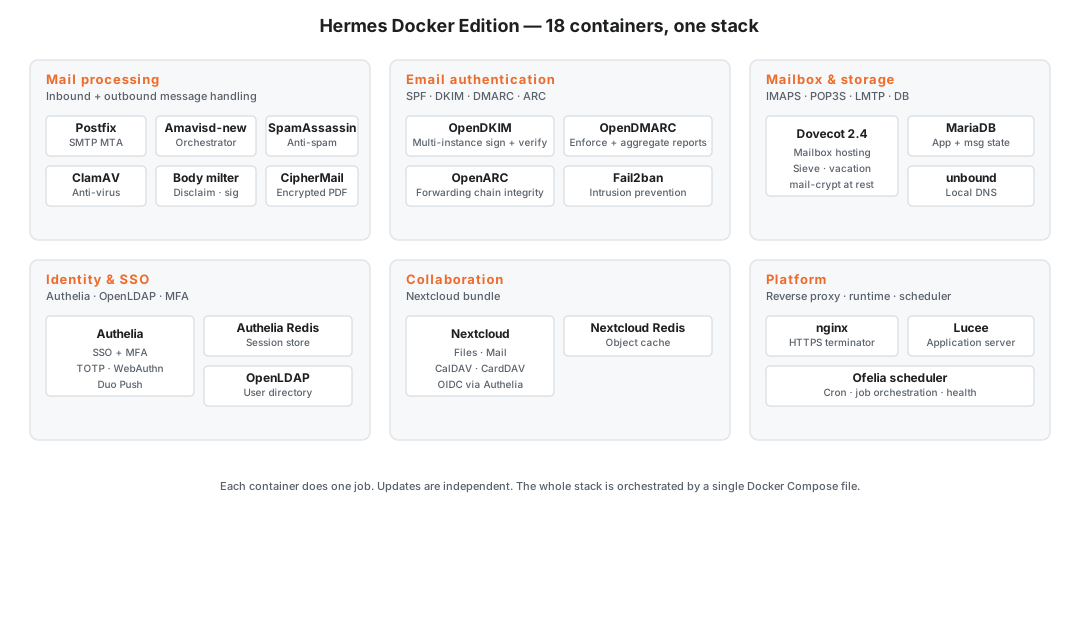
A Hermes Docker Edition install runs eighteen tightly-scoped containers coordinated via Docker Compose, grouped by function: Mail processing (Postfix, Amavisd-new, SpamAssassin, ClamAV, body milter, CipherMail); Email authentication (OpenDKIM, OpenDMARC, OpenARC, Fail2ban); Mailbox & storage (Dovecot 2.4, MariaDB, unbound DNS); Identity (Authelia, Authelia Redis, OpenLDAP); Collaboration (Nextcloud, Nextcloud Redis); and Platform (nginx, Lucee, Ofelia scheduler).
Built for production
Hermes ships with the operational ergonomics production deployments expect: an AdminLTE-4 administrator console with real-time dashboards, message statistics, and searchable system event logs; a self-service end-user portal; a five-tier storage layout (Config, Data, Archive, Vmail, Nextcloud) that scales independently per tier; an internal Certificate Authority for S/MIME; a console firewall and DNS resolver managed entirely from the web UI. The same console that powers a single-server install powers a multi-appliance MSP deployment.
Hermes is developed and maintained by Deeztek. Community support happens on GitHub Discussions, Matrix or Telegram channels; commercial support is available through Pro Edition support incidents. Get started with the free Community Edition or see Pro pricing.